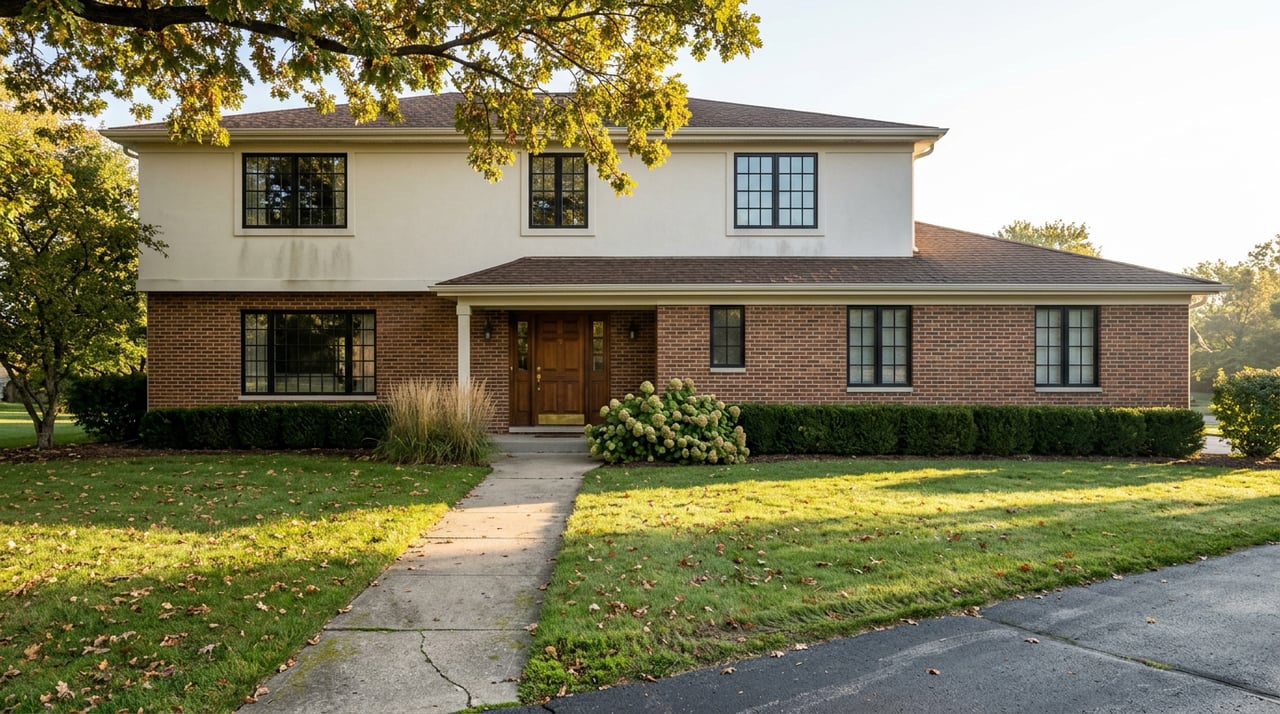
Walk the tri-levels on Oak Avenue in Brookfield and then walk a few blocks north into La Grange Park, and you will start noticing the same house. Same low-pitched roofline stepping down to a sunken lower level. Same wide front gable. Same attached garage bolted onto a floor plan that a construction crew poured into the ground on repeat for over a decade. That is not déjà vu. It is the Hladik family's Coronet Construction Company, which built more than a thousand homes across Brookfield, La Grange Park, and Riverside between the late 1940s and early 1960s, running the same handful of models block after block regardless of which village line they landed on.
So here is the question a buyer comparing these two towns should actually be asking. If a meaningful share of the housing stock in La Grange Park and Brookfield came out of the same builder, the same era, and often the same blueprint, why does a home in La Grange Park sell for close to 40 percent more?
The gap, as of right now
As of January 2026, the median sale price in La Grange Park was $545,000, up 12.4 percent from a year earlier, with homes selling in about 40 days. Brookfield's median sale price that same month was $390,000, up 14.7 percent year over year, with homes selling in about 48 days. Both markets are moving fast and both are appreciating at a similar clip. The gap between them, roughly $155,000, has held steady rather than closing.
That gap is not small change, and it is not explained by construction quality. A Coronado tri-level built by Coronet in 1952 used the same materials and the same crew logic whether it landed on a Brookfield street or a La Grange Park one. The Riverside-Brookfield Landmark's own history of the company notes that the same "Tri-Level Coronados" turned up in Brookfield, in Riverside, and that La Grange Park was "loaded with them, too." If the bones are frequently identical, the price difference is a location premium, not a house premium. The real work is figuring out what, specifically, that premium is buying.
What the premium is actually paying for
A few things separate the two villages that have nothing to do with square footage or finishes.
La Grange Park sits immediately adjacent to downtown La Grange's Burlington Avenue corridor, a walkable stretch of shops and restaurants that functions as the shared commercial identity for both towns even though it technically belongs to its neighbor. That proximity is part of what a La Grange Park buyer is paying for: being a short walk from an established, active downtown without absorbing La Grange's own higher price tags.
La Grange Park has also built a specific market reputation. The Village's own materials point to a Forbes recognition naming it one of the most stable housing markets in the country, and its housing stock, per the Village, ranges from early 1900s homes through the postwar Joern-built houses of the 1940s through 1960s to new construction, spanning Victorians, bungalows, Arts and Crafts, and foursquares alongside the Coronet-era ranches and tri-levels. That range and that stability narrative both feed into how the market prices the town relative to its neighbors.
School district lines matter here too, in a narrower sense than most listings suggest. Some Brookfield addresses sit within the Lyons Township High School district, the same district that covers La Grange Park, while other Brookfield addresses fall within Riverside Brookfield High School's boundary instead. That split means two Brookfield buyers a few blocks apart can be shopping in different attendance zones entirely, which is one more variable layered on top of a builder history that otherwise treats the two villages as interchangeable.
The tax twist that changes the math
Here is the part of the comparison that most buyers skip, and it cuts against the assumption that a lower purchase price automatically means a better deal.
La Grange Park's effective property tax rate runs around 2.64 percent, a rate that sits above much of the surrounding region. Brookfield's own published figures put its average annual tax bill at roughly $7,169 on a median home value near $392,000, which works out to an effective rate closer to 1.8 percent.
Put those two numbers together and the total cost picture gets wider, not narrower, than the sale price gap alone suggests. A La Grange Park buyer is paying roughly $155,000 more up front and then paying that premium at a materially higher tax rate every year after closing. The town with the lower purchase price also carries the lighter relative tax load. That is the opposite of what a simple median-price comparison implies, and it is the number a buyer weighing these two villages should run before deciding that the cheaper option is automatically the better value, or that the pricier one is automatically overpriced.
| La Grange Park | Brookfield | |
|---|---|---|
| Median sale price (Jan. 2026) | $545,000 | $390,000 |
| Year-over-year change | +12.4% | +14.7% |
| Typical days on market | ~40 | ~48 |
| Effective property tax rate | ~2.64% | ~1.8% (calculated) |
So what is the buyer actually choosing between
Strip away the assumption that price tracks construction quality and the decision becomes clearer. Buying in La Grange Park is buying proximity to an established downtown corridor, a documented reputation for market stability, and a broader mix of housing eras from Victorian to new construction, at a higher purchase price and a higher ongoing tax rate. Buying in Brookfield, including a Coronet-era tri-level or ranch built by the exact same company on the exact same model line, gets a buyer into a comparable structure for tens of thousands less, with a lighter annual tax bill, provided the buyer confirms which high school boundary a specific address actually falls in before assuming anything about that split.
Neither answer is wrong. The mistake is assuming the sale price difference is the whole story, when the builder history says the houses often started identical and the tax data says the annual cost gap runs even wider than the sticker price implies.
FAQ
If two homes were built by the same company in the same era, should they be priced the same today? Not necessarily. Construction era and builder explain the bones of a house, not the block it sits on, the commercial corridor it is near, or the tax rate attached to its village. Those factors move price independently of who poured the foundation.
Does a lower effective tax rate always mean a lower total tax bill? Only if the purchase price is also lower or comparable. A lower rate on a much higher-valued home can still produce a larger bill in dollar terms. The rate and the price both have to be checked together, which is exactly what makes the La Grange Park and Brookfield comparison useful as a real example.
How do I find out which high school district a specific Brookfield address falls into? Because Brookfield splits between Lyons Township High School and Riverside Brookfield High School depending on address, this is worth confirming address by address before making assumptions based on a neighboring block.
If you are weighing La Grange Park against Brookfield, or trying to figure out what a specific Coronet-era tri-level or ranch is actually worth once taxes and location are factored in, that is exactly the kind of comparison Vitell Realty walks through with buyers block by block. Schedule a consultation and bring the addresses you are considering.